

Press & Reviews
Jarred
Dunn
concert pianist
Press & Reviews



To all the world, Henryk Górecki’s best-known type of music is long-form — the symphonic template — the most celebrated of which is his hauntingly marvellous Symphony of Sorrowful Songs, the Third Symphony, that has become a million seller — made so by the breathtaking sonorities of Dawn Upshaw. It was matched — possibly made more rich, transparent and meaningful — by the Polish National Radio Symphony Orchestra and a more spiritual reading by Zofia Kilanowicz.
But for all the emotionally and powerful symphonic and choral works, little is known, much less performed, of Górecki’s smaller offerings. Spanning 1955 to 2008, Górecki’s World of the Piano presents his complete works for one and two pianos, many composed in the dark and difficult context of post-war Poland. Jarred Dunn performs the solo works and is joined by the composer’s daughter Anna Górecka for the duets.
Toccata For Two Pianos, Op. 2, the brilliant outburst of Four Preludes, Op. 1, the shimmering quietude of the Berceuse, Op. 9, the longest of the Chopinesque miniatures in his Intermezzo, and the extended Piano Sonata No. 1, Op. 6 testify to the diversity of Górecki’s output. The music here gives full reign to his characteristically high, shimmering, patiently sustained chords along with bell-like ones which mirror the intervals confined to shorter, more tentative melodic cells. Although Górecki’s piano works are difficult to give expression to, clearly Górecka and Dunn play them with deep meaning and absolute mastery.
Chopin’s Diary: The Mazurkas … Ever-present in Dunn’s readings is the characteristic emphasis on the second beats of the bars, but the accenting is more agogic than percussive. The “stamping of the feet” that the dictionary definition of a mazurka tells us ... is here tamed by Dunn into something more formal, cultured, and refined. This is the ballroom of a Polish aristocrat ….
Listening to Dunn’s readings of the mazurkas put me in mind of Rubinstein’s way with Chopin .... For the most sensitively executed, lovingly played, and expressively communicated performances of Chopin’s mazurkas, I accord Jarred Dunn the highest recommendation ....
Some of the finest Chopin since Rubinstein.

Until the arrival of this ATMA album, the discographic availability of the piano music of the Pole Górecki remained incomplete. That problem has now been solved with the recording of the Five Pieces for Two Pianos, Op. 13 on Górecki’s World of the Piano. Canadian Jarred Dunn is already a leading authority on Górecki’s music (he will be releasing a book on the subject, Górecki: The Piano Music, with Bloomsbury Publishing), but the interpretive authority is raised a notch here with the presence of the composer’s daughter, Anna Górecka, at first piano on two of the program’s two-piano pieces.
These Five Pieces for Two Pianos, Op. 13 in serial form are a rare example of the Polish composer’s exploration of this technique, a far cry from his famous Symphony No. 3, “Sorrowful Songs”. The conceptual rigour of the Pieces is magnified in this take by Dunn and Górecka’s excellent sense of colour.
The Toccata, Op. 2, also for two pianos, is an example of the percussive, motoric style (reminiscent of Mossolov) of some 20th-century Eastern European music, and is rendered with a fair amount of power by the two pianists. A good piece that punches effectively.
The rest of the programme consists of pieces for solo piano, all played with panache by Dunn. The universe evoked is generally quite similar to that of the Harpsichord Concerto, with a rough tonalism supported by a deliberate sense of rhythm, as in Shostakovich. Occasionally there is a shift towards more atonalism, but this is a field of investigation that Górecki has rarely explored in his career. It is also one of the reasons why the Pole was for a time included in the list of ‘minimalist’ composers (along with Glass and Reich) or ‘spiritualist’ composers (like Arvo Pärt). Although a few choral and orchestral pieces can be loosely associated with them, Górecki remains very much apart from these schools. This is even more obvious when listening to this complete piano works album, in which there are very few examples that can be associated with the above-mentioned genres (Lullaby, Op. 9 and Intermezzo could perhaps be seen as sad cousins of Pärt’s Für Alina).
Instead, we discover a modern artist with an unmistakably personal discourse, whose grey, foggy sensibility is splendidly brought to life by Jarred Dunn. Enjoy the density of the Four Preludes, Op. 1, the stylistic eclecticism of From a Bird’s Nest (where post-webernism rubs shoulders with Shostakovich and folklore), the abstract sensuality of the Sundry Pieces, Op. 52 and the fury of the Sonata No. 1, Op. 6.
Górecki’s World of the Piano is an important album of the highest artistic stature.
This album’s 11 pieces create a well-planned trajectory through Brahms’s poetic music, and Jarred Dunn demonstrates a natural ability in performing this music.
The album opens with three pieces from Klavierstücke, Op. 118, perhaps the most well-known opus of Brahms’s late piano music. Dunn gives us a taste of Brahms’s various meditative styles: first, the dramatic and emotional Intermezzo in A minor; then, the lyrical Intermezzo in A major (the Brahms Intermezzo), beautifully played with interior lines of counter-point; and ending with the foreboding, intense, chromatically colourful Intermezzo in E-flat minor.
Two lesser known works from Klavierstücke, Op. 76 were written while Brahms studied Chopin’s music, and have an air of solemn nostalgia. Dunn handles the repetitive forms of these with expertise, emphasizing their inner voices and hidden melodies.
With frequent shifts of rhythm, harmony, and melody, the two E major Intermezzi from Fantasien, Op. 116 are often surprising. Here, Dunn creates the image of a muted spotlight blinking on and off, shifting its focus from one motive to another. His deft voicing and clarity speak to his understanding of the works of Brahms’s idol, J. S. Bach.
Brahms called the three Intermezzi, Op. 117 “lullabies of [his] sorrows.” Though quietly lamenting, each contains moments of agitation. Dunn’s interpretations are timeless and still, but never halt the music’s natural momentum. His soft sound is at once full-bodied and resonant, and unthinkably quiet.
The final piece, the first Intermezzo from Klavierstücke, Op. 119, was no doubt carefully chosen to leave listeners in a state of reflection. Dunn’s sensitive playing of the Adagio calls to mind Clara Schumann’s description of it as Brahms’s “grey pearl.” His precision, sense of musical direction, and knowledge of the piano’s every colour are on display here.
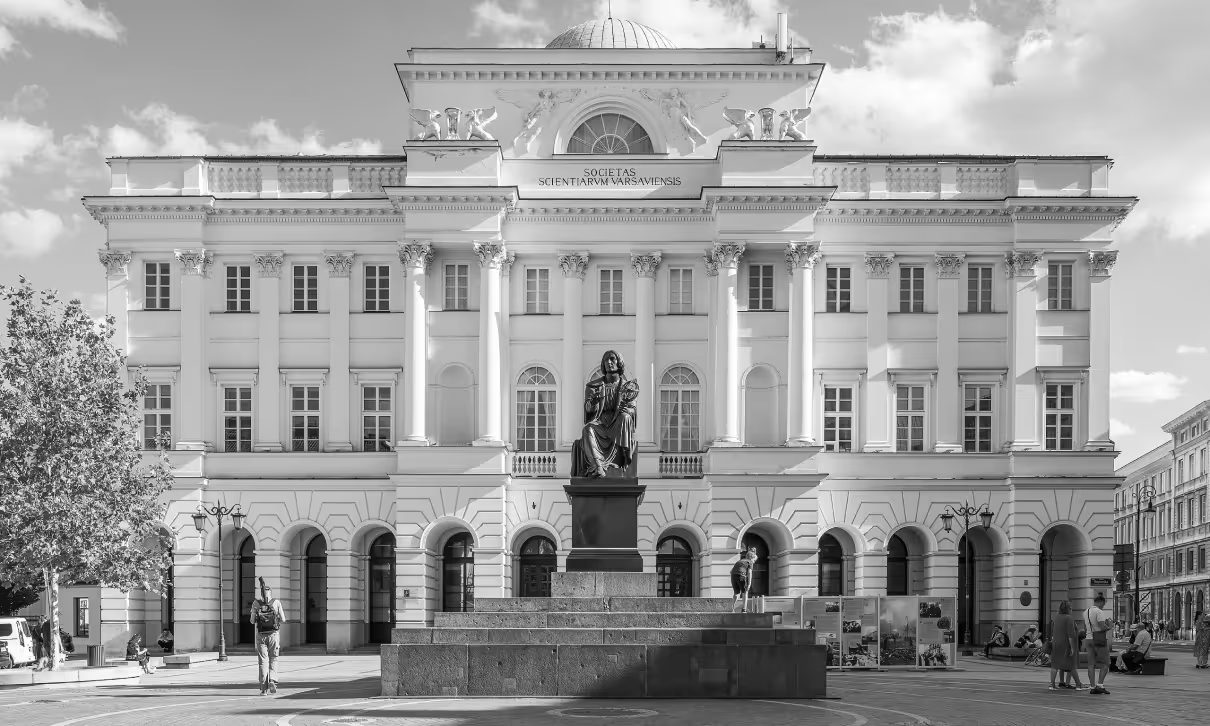
It is not easy for a foreigner to play Chopin in Warsaw — the city of the International Fryderyk Chopin Piano Competition ... Chopin is considered a representation, an emanation and the quintessence of Polishness. Is it then possible for a foreigner to play Chopin if they were raised without Polish willows, kujawiaks and obereks?
A Canadian, Jarred Dunn, is one of the people who can. The playing of the brilliant Canadian performer did not lack the “Polishness” that he had a chance to learn thoroughly from the best Polish teachers during his Master’s Studies in Katowice or later in Bydgoszcz. The “Polishness” was audible in every piece: from Nocturne in C minor, Op. 48 with its drama that was built by the pianist from the very first chords and the tragic ending, through Scherzo in E major, Op. 54, played with a great sensitivity, brilliant sound and technical mastery, to the brilliant Polonaise-Fantaisie, Op. 61 ....
In every piece Jarred Dunn showed his virtuosity, amazing sense of style, elegance and noble — but not excessive — sensitivity, passion — without being pathetic, beautiful piano and powerful forte, melodious — but not sugary — cantilena, broad phrasing and very rich, nuanced range of sounds.

This new recording by Canadian pianist Jarred Dunn and Polish pianist Anna Górecka features the complete works for solo piano and two pianos by Henryk Mikołaj Górecki (1933-2010). Listeners more familiar with Górecki’s Symphony No. 3 (Symphony of Sorrowful Songs) will discover a more dissonant and austere soundscape. A variety pack of works composed from 1955 through 2008, the album features sets of miniatures and pieces written for specific people or occasions. These showcase Górecki’s love of the piano and the variety of sounds it is capable of making — from spare, lyrical lines to dense textures that verge on confrontational. Dunn’s intergenerational, cross-cultural collaboration on the two-piano pieces with Górecka, the composer’s daughter, results in an album that stands out as a unique, interpretive masterpiece.
The Toccata for Two Pianos is complex, angular, dissonant and, above all, virtuosic. Full of complicated timing and syncopation, it requires precise co-ordination between the performers. Górecka (Piano 1) and Dunn (Piano 2) are kindred spirits and an ideal duo, fully in control of the work’s complexities. Colour, nuance, and singing tone resound in even the most forbidding passages. Voicing and clarity of phrasing are impressive in music of such rapid-fire density.
Of the Five Pieces for Two Pianos (previously unrecorded by a major label), the first three are just a minute each. Their Webern-like, pointillistic style uses the full range of the piano and requires arduous keyboard gymnastics. The performers’ hands jump incessantly around the keyboard, switching dynamics, tone, articulation, or chords in milliseconds, while maintaining rhythmic cohesion. A duet in this style is impossible to execute without musical mind reading, not to mention superlative memory, listening, and technique. Masses of sound fragments must be turned into phrases, many of which change on a dime from single tones to piles of fast-tumbling notes. In the face of these obstacles, Górecka and Dunn’s superb rhythmic and dynamic authority turns abstract structures into artful chamber music. This is a landmark premiere recording by two virtuosi.
Many of Górecki’s short solo pieces are tiny pedagogical etudes for specific techniques. One might think the shorter the piece, the easier, but in fact it is more difficult to create natural flow and musical meaning from a miniature. The listener is rewarded, even after a single hearing of these expertly played tone poems, by Dunn’s fine-tuned sense of line and musical contrast. The nine short solo pieces in From a Bird’s Nest, particularly, come across as the musical equivalent of aphorisms — short observations that contain some pertinent truth or a satisfying conclusion.
Dunn brings out the subtle, spacious, often haunting atmospheres of Górecki’s lyrical piano works with remarkable perceptivity. Some give the impression of being simple to play, such as Lullaby, Op. 9, with its slow-moving counterpoint over an ostinato. But four-voice counterpoint is never simple, and Dunn’s incredibly sophisticated control of tone quality and sustained notes is a quality for which he is already well-known. Intermezzo is an especially lovely piece in which he creates luminous tones as if from carillon bells of all sizes. Four Preludes, Op. 1, feature a more intellectually contemplative style in their lyrical sections. The Piano Sonata No. 1 contains much variety from Bartók-like percussiveness and Polish folk-music influences, to heartfelt religious-style chordal textures, with Dunn’s brilliant virtuosity on display throughout.
With his previous albums, Dunn has shown he is a master of Brahms and Chopin. In collaboration with Górecka, he demonstrates not only his mastery of the intricacies of Górecki’s music, but his commitment to authenticity and versatility. Dunn’s sharing of this little-known music of Poland (his second home) makes the album a triumph amongst recordings of 20th– and 21st-century piano music. How lucky we are that Dunn and Górecka have offered this wonderful gift to the piano world.

Undoubtedly, one of the most important and powerful moments of the concert was the performance of the ever-growing pianist Jarred Dunn ... the 1st place winner of the VII International F. Chopin Piano Competition in Vilnius ... Jarred Dunn, the critically-acclaimed Canadian pianist, who, it has been said, is an evocative, technically-perfect virtuoso, revealed all of this on the stage of St. Catherine's Church this evening.
The audience expected much from F. Chopin's musical pearls, the Four Scherzi Op. 20 (B minor), Op. 31 (B-flat minor), Op. 39 (C-sharp minor) and Op. 54 (E major). Mr. Dunn's interpretations are admirable; he has subtle, refined sound, and an impeccable technique; spiritual and uplifting performance.
He is a warmly acclaimed performer who can be deservedly called a piano sound color magician.

Highly acclaimed pianist Jarred Dunn performed a solo and chamber music recital with violinist Jeanel Liang for a rapt audience in Kingston, Ontario’s Isabel Bader Centre for the Performing Arts on January 16, 2023.
The two sets of Chopin Mazurkas, Op. 50 and Op. 56, that comprised the first half of the recital were delightful — unique and slightly unusual interpretations in places that brought out the traditional mazurka rhythms and inner voices without being affected …. These are more introverted pieces, unlike many of Chopin’s Mazurkas. In Mr. Dunn’s words, they “contain Chopin’s innermost monologues.”
Mr. Dunn plays in a relaxed style but with a high level of fine-motor control, keeping his hands close to the keyboard. He has what I call “Chopin” hands — with long, slender fingers — and like a good organist, he easily maintains a sustained legato. His pedalling in this performance was exquisite — so unobtrusive as to be almost invisible.
There is a particular style of playing Chopin, popular in the nineteenth century but less so now, which creates slight asynchrony between the left and right hand parts. With some performers, it sounds eccentric or contrived and disturbs the musical flow, but a skilled musician can produce heightened, sensuous phrasing and create unexpected rhythmic emphases similar to a style common in some jazz piano playing. Mr. Dunn managed to incorporate asynchrony in such an elegant and subtle way, and with such refined control of phrasing, that it enhanced the harmonies and didn’t intrude at all.
Jeanel Liang, who joined Mr. Dunn in the second half for Brahms’ Sonata for Violin and Piano in G Major, Op. 78, earned my sincere praise for her beautiful tone, effortless bow control and overall musicality. The pair’s well-coordinated performance was not only sensitive, but also dramatic in all the right places without being too showy — an ideal performance of a rather understated piece of chamber music.
OF OPERAPROMS (TALLINN)

Mr. Dunn’s playing is not only the result of great teaching. Dunn possesses Lupu’s precision, sense of where the music is going, and knowledge of how to use the piano’s potential for colour. Like Radu Lupu, Jarred Dunn is a “thinking” pianist, who knows how to place every note without the end result sounding calculated. His Op. 119, No. 1 is serene contemplation free of exaggeration, an entirely successful creation.
Jarred Dunn, a poet of the piano, plays Brahms with an innate and lyrical subtlety that may change the way listeners think of his music. Yes, we hear Brahms’s complex cross-rhythms, syncopations, and large chords, but they are not on display as athletic feats. To truly absorb Brahms in Solitude, do listen to each piece more than once. Perhaps because they are fairly short, slow pieces, we need more than one listening to fully process their intricacy and meaning. In Dunn’s playing, the late Brahms music has a faithful interpreter who plunges into the inner life of each piece. Surely Mr. Dunn would appreciate listeners enjoying contemplative exploration of this beautiful album.
His enthusiasm was evident as he captured our attention with his impeccable technique and passionate interpretations .... He had an unassuming and humble air about him as he took the stage, which belied the depth and skill he exhibited …. The audience listened with rapt attention to the beauty of the Polish composer Karol Szymanowski’s Preludes, Op. 1, the soul stirring chords of Chopin [Ballade, Op. 47], the joyful strains of Schubert’s Sonata D. 664 and the sparkling climax of Schumann’s Piano Sonata in F-sharp minor, Op. 11.
The cheers when his fingers left the keys for the final time were just as loud as any hockey game.

Ever since his Symphony No. 3 ("Symphony of Sorrowful Songs") propelled him to unheard-of heights for a contemporary composer, Henryk Górecki has been known mostly for orchestral and choral works. He was not a prolific writer for the piano; this album contains his entire output of music for one or two pianos. Yet the music's significance is attested to by the presence of pianist Anna Górecka, the composer's daughter, on the two-piano works. She was the teacher of the principal pianist, Jarred Dunn, who has a fine feel for the combination of folk nationalism and atonal influences that characterize Górecki's early works. Most of the music comes from the first part of Górecki's career. At first, he was influenced by Bartók, and the set From a Bird's Nest, Op. 9a, consists of short pieces that recall those of Bartók's technically simple but never unsophisticated Mikrokosmos.
Like other composers of his day, Górecki flirted with serialism, and the Five Pieces for Two Pianos, Op. 13, from 1959, offer an interesting example of his use of the method (although he disowned much of his serialist music), with a treatment of rhythm that is complex but not oriented toward the total serialism procedures of the day. Along the way are small works of personal significance, some of them from the more accessible later period of his work, and falling under the Polish category known as sonorism. Sample the Quasi valse, from the Sundry Pieces, Op. 52 (which gathers works from various periods); it is a humorous take on the experiences of those who have listened to piano practicing. The album may stand to the side of Górecki's main output, but it comes from musicians who know his music well, and it will be of great interest to the many who enjoy the work of this Polish composer.